
See · AEO
Win back the AI answers that send buyers elsewhere.
Gane asks AI assistants the questions your buyers ask and shows who they name instead of you. It works out what each lost answer is worth in pipeline, then drafts the page that wins it back.
Your first recommendations within minutes. The Team plan is free for 30 days.
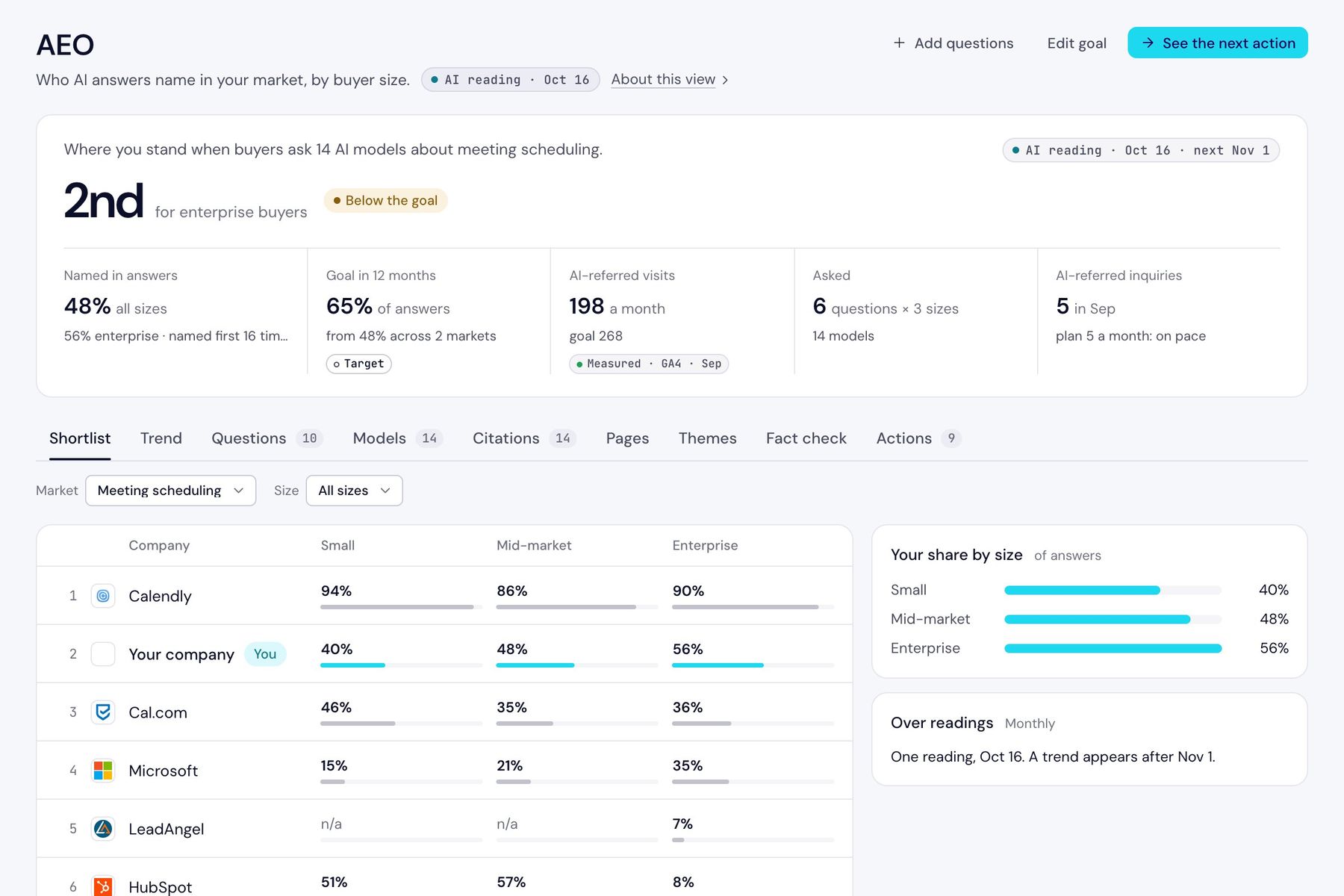
Sample workspace · Gane’s own demo data
// One buyer question
Every question ends in something to do.
For each question, Gane shows which AI apps name you, who they name when they don’t, and the pages they read to decide. Then it raises the piece of work most likely to change the answer. Pick a question to see how it reads.
A buyer asks · Direct question
“What’s the best billing software for a usage-based SaaS company?”
Named in 3 of 5 AI apps
- ChatGPTNamed 3rd
- GeminiNot named
- Google AI ModeNamed 2nd
- Google AI OverviewsNot named
- PerplexityNamed 4th
Who they name instead
Ledgerly
Named in 5 of 5 answers, first in 4
Countwell
Named in 4 of 5 answers
Meterbase
Named in 2 of 5 answers
The sources they cite
ledgerly.com/compare/ostrow
Competitorcited in 3 answers
billingstackreview.com/usage-based
Third partycited in 3 answers
ostrowbilling.com/product
Youcited in 1 answers
The page the answers read most is Ledgerly’s own comparison with you. You don’t have one of your own yet.
The action Gane raises · from “Pages AI answers cite that you have none of”
Build a comparison page with Ledgerly that answers the question in its first lines
$110K to $170K in pipeline a year · Gane drafts it, and Alex approves it
Sample workspace · companies and sites are fictional, figures are illustrative
// More than a visibility score
A share of answers doesn’t tell you what to do on Monday.
AEO tools report how often you’re named and whose pages get cited. Gane reports that too, but it doesn’t stop there.
It puts a pipeline figure on each lost answer, from the AI-referred visits your plan expects and what those visits turn into. A lost answer then competes for your week on equal terms with a slipping page or a costly campaign.
| What you get | A typical AEO tool | Gane |
|---|---|---|
| Which AI answers name you, and how often | Yes | Yes |
| Who is named instead, and the sources the answers cite | Yes | Yes |
| What each lost answer is worth in pipeline, measured against your plan | No | Yes |
| The page to write or fix, drafted in your voice | No | Yes, approved by a named person |
| What the answers said after the page went live | Sometimes | Yes, from a baseline |
| AI answers ranked against search, paid, social and programs | No | Yes, in one list |
// What gets asked
Your questions, asked where your buyers ask them.
Gane reads AI answers in three ways. Each one fills a gap the others leave.
Every week
Your own questions
The questions you choose are put to ChatGPT, Gemini, Google AI Mode, Google AI Overviews and Perplexity every week. On Scale, up to 100 of them are read every day.
Every month
The reading of your market
Fourteen AI models are asked about each market Gane reads, in six phrasings and at three buyer sizes. That’s where the standings against your competitors come from.
When you need one
A market you make
If none of Gane’s categories fits what you sell, make your own. Gane drafts 15 to 30 buyer questions for it, and nothing is asked until you approve them.
Growth reads 3 markets and 25 questions of your own. Team reads 5 markets and 100 questions, and Scale reads 10 markets and 250 questions.
// What Gane watches
Eight checks run on your AI answers, and each one can raise an action.
Some look at what the answers say. Others look at whether AI assistants can read your site at all, because a page they can’t fetch is a page they can’t cite.
- 01
Questions that leave you out
Finds the kinds of buyer question where AI answers rarely name you, market by market.
Reads: The monthly reading
- 02
Pages the answers cite that you don’t have
Comparison, pricing, review and guide pages the answers lean on in your market, where you have none.
Reads: The answers’ citations
- 03
A competitor passing you
Tells you when a competitor moves past you in how often the answers name it.
Reads: This reading against the last
- 04
What the answers get wrong
Compares what the models say about you with your product facts and your site, and lists what they contradict.
Reads: The answers, your facts, your site
- 05
Claims your own pages contradict
Checks the claims the weekly answers make about your prices, plans, integrations and features against your pages.
Reads: The weekly answers, your site
- 06
AI crawlers shut out
Checks that robots.txt lets in the crawlers AI assistants use to read pages while they answer.
Reads: Your site, weekly
- 07
AI crawlers in your server logs
Watches the errors AI crawlers meet on your site, and the fetches for people that start to fall away.
Reads: Server logs
- 08
Buying questions on Reddit
Finds threads asking which product to choose that don’t mention you, starting with the ones AI answers cite.
Reads: The Reddit watch
// Did it work?
Every page is measured against what the answers said before.
- 1
The action names the question
A finding about a lost answer carries the question itself, and the program it opens is offered that question.
- 2
The brief names up to five
Each page or guide can name up to five buyer questions it should win. Gane asks them every week from then on.
- 3
A baseline before it goes live
On the day the page goes live, Gane writes down what the answers said in the weeks before.
- 4
The readout reads since then
Whether the answers name you and cite the page, which AI assistants read it, the visits they send and the forms filled in on it.
Ostrow vs Ledgerly · AI answers
Readout, 28 days since it went live
- Named for its questions
- 11 of 24 answers since it went live, from 3 of 22 before
- Named first
- 4 of 24 answers
- This page cited
- 9 answers, on ChatGPT, Google AI Mode and Perplexity
- AI assistants reading it
- 46 fetches for a person asking
- AI-referred visits
- 38 visits to the page
- Leads
- 4 forms filled in on the page
Gane says what changed since the page went live. It doesn’t claim the page caused it.
Sample workspace · companies are fictional, figures are illustrative
AI-referred visits and the AI crawlers reading your site sit on the Traffic screen, next to every other source of visits.
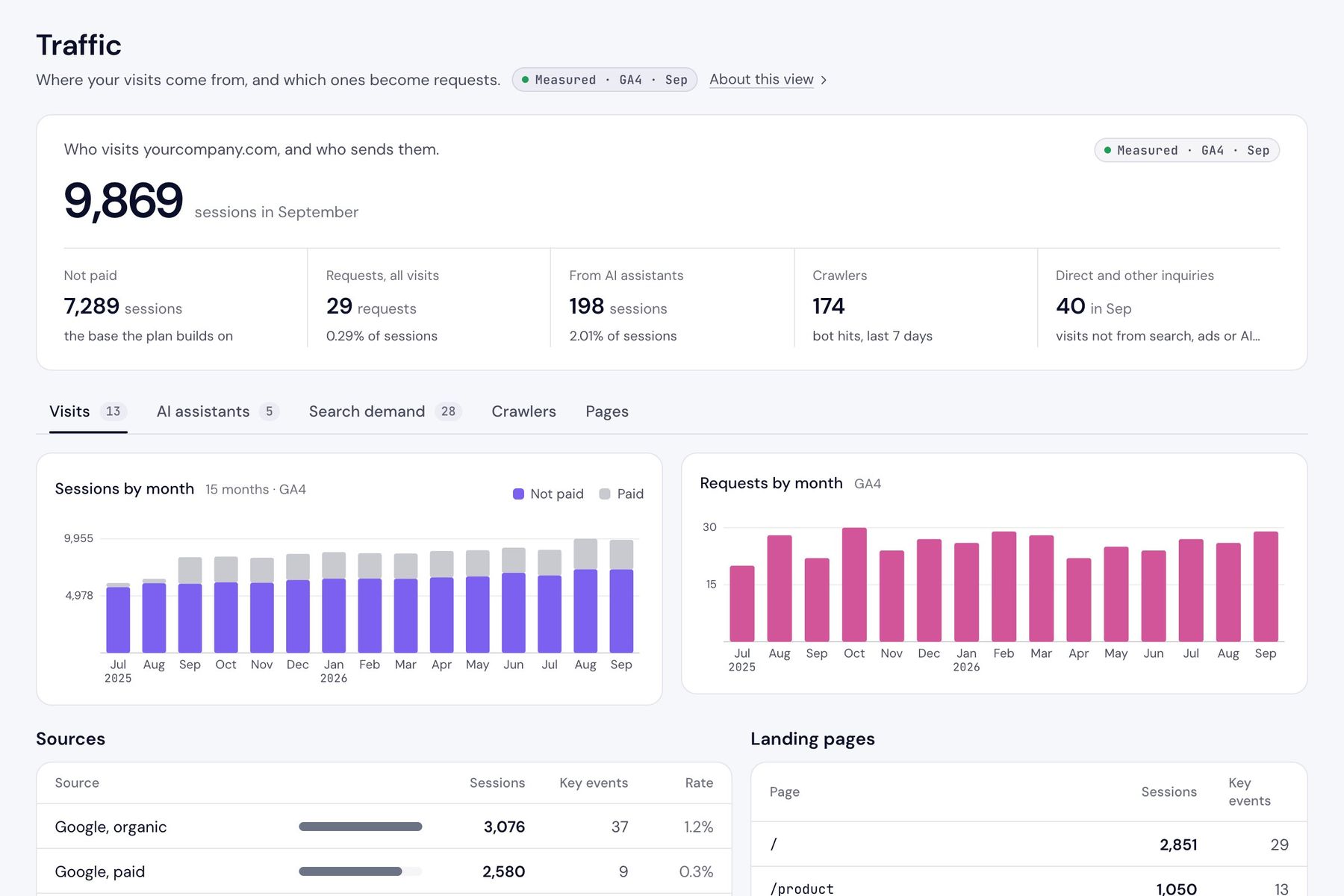
Sample workspace · Gane’s own demo data
// The Gane Index
The Index shows your category. Your workspace shows your number.
The Gane Index is free and public. Every month it asks fourteen AI models which software they’d recommend in hundreds of categories, and traces the sources behind each answer.
Your workspace starts from that reading. It then asks your own questions in your own markets, ties each answer to your plan and does the work to change it.
Read the Index ↗| Compared | The Index | Your workspace |
|---|---|---|
| Who it’s for | Anyone, with no account | Your team |
| Questions | The category’s standard set | Yours, plus your markets’ |
| How often | Monthly | Weekly, or daily on Scale |
| What it adds up to | Who AI recommends | What each answer is worth in pipeline |
| What happens next | You decide | Gane drafts the fix for approval |
// FAQ
Questions about AEO.
What is AEO?
AEO stands for answer engine optimization, and you may also hear it called AI visibility. It’s the work of getting AI assistants like ChatGPT to name you when buyers ask them what to buy, the way SEO is the work of showing up in Google.
How is Gane different from an AEO tool?
AEO tools report how often you’re named and whose pages get cited. Gane reports that too, then puts a pipeline figure on each lost answer against your plan and drafts the page that could change it. A named person on your team approves it before it goes out.
Which AI apps does Gane ask?
Your own questions go to ChatGPT, Gemini, Google AI Mode, Google AI Overviews and Perplexity every week, and on Scale up to 100 of them are read daily. Each market Gane reads also gets a monthly reading across fourteen AI models, in six phrasings and at three buyer sizes.
How does this relate to the Gane Index?
The Gane Index is free and public. Every month it reads what fourteen AI models recommend in hundreds of software categories. Your workspace starts from that reading, then asks your own questions in your own markets and ties each answer to your plan.
What if Gane doesn’t cover my market?
You can make your own. Name it, and Gane drafts 15 to 30 questions your buyers would ask. Nothing is asked until you’ve approved between 5 and 30 of them, and from then on they’re asked every week.
See which answers are worth winning back.
Enter your website, and Gane will show where AI answers leave you out within minutes.