
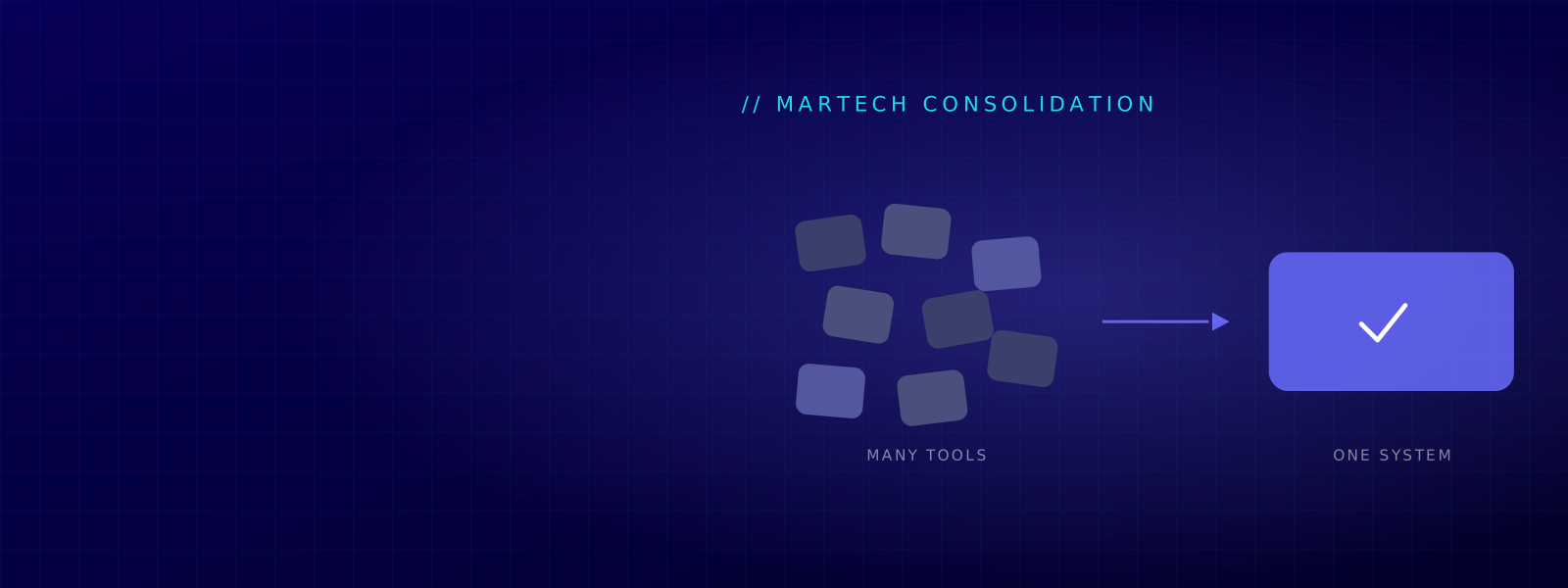
Martech Consolidation: Cut the Stack, Keep the Outcomes
Budget season has a familiar ritual. Finance asks for the list of tools, someone tallies the annual spend, and the instruction comes back: cut it. The trouble is that cutting a martech stack the wrong way costs more than it saves. Kill a tool the team actually depends on and you do not reduce the work, you just make it harder. The goal is not a smaller bill. It is a leaner stack that produces the same outcomes with less overhead.
Here is how to consolidate without cutting into muscle.
Why stacks sprawl in the first place
Martech stacks rarely grow by design. They grow one point solution at a time. A specific problem shows up, a specialized tool solves it, and it gets added. Do that for a few years across a few people and you end up with a dozen tools that each do one thing, overlap in three others, and only connect through manual effort. No one chose the sprawl. It accumulated.
The real cost is between the tools, not on the invoice
The license fees are the visible cost, and they are usually not the big one. The larger cost is the tax of running many disconnected tools: exporting from one to import into another, reconciling records that disagree, rebuilding the same tracking in three places, and the coordination time that connective work demands. A consolidation that only chases license savings misses most of the prize. The bigger win is removing the work that lives in the gaps between tools.
Audit before you cut
You cannot consolidate what you have not mapped. Start with a simple inventory: list every tool in the stack, what job it does, who uses it, and how often. Two patterns will jump out. Overlap, where several tools claim the same job, and shelfware, where a tool is paid for but barely used. Those are your first candidates.
You can get a strong first pass in an afternoon with an LLM you already use. Paste in the list of every tool and a line on what each is for. Leave the dollar figures out: the goal here is the shape of the stack, not the bill. Then ask it to group the tools by the job they do and flag where more than one claims the same job. Ask it to point out the biggest seams too: the places where work has to be exported from one tool and imported into another, or tracked in two systems that do not talk. The model will not have your full context, so treat the output as a draft to react to rather than an answer. But it turns a blank page into a marked-up map you can refine, and it surfaces the overlap and the gaps far faster than starting cold.
What to consolidate, and what to keep
Not everything should collapse into one box. Keep the specialized systems of record where they are genuinely best in class, your CRM being the obvious one. What consolidates well is the connective and workflow layer: the planning, coordination, content, and reporting that currently stretch across many tools and generate most of the hand-off cost. Pull that layer together and the point tools that remain have something to plug into, instead of a person in between.
Consolidate around an operating layer, not another point tool
The mistake is to consolidate by buying one more tool that does a bit of everything and a lot of nothing. The better move is to consolidate around an operating layer that sits above the stack you keep, coordinates the work across it, and reduces the number of places a person has to touch. You are not trying to own every function. You are trying to remove the seams. See how the integrations connect.
Measure the win honestly
When you report the result, count all of it, not just the canceled licenses. The real return is three parts: the spend you removed, the time the team reclaims from connective busywork, and the reduction in hand-offs and errors that come from fewer disconnected systems. Framed that way, consolidation stops being a cost cut and becomes a capacity gain.
Consolidation done well is not about spending less for its own sake. It is about removing the overhead between tools so the same team produces more. Audit what you have, keep the specialized systems, consolidate the connective layer around an operating system, and measure the reclaimed time, not just the saved licenses.
Ready to find the overlap in your own stack? Start with the platform.