
Do More With the Team You Have: The Lean B2B Marketing Operating Model
Every B2B marketing leader has heard some version of it heading into budget season: hit a bigger number next year, with the same team, or a smaller one. The reflex is to argue for more headcount, or to start cutting scope. Both miss the real problem. For most teams the constraint is not budget and it is not talent. It is capacity, and specifically the capacity lost to coordinating the work rather than doing it.
Here is the operating model that lets a lean team run the work of a much larger one, without hiring for it.
The real cost of marketing is coordination, not software
Look at where a marketing team’s hours actually go. Not to the creative or the strategy, but to the connective tissue around it: briefs, hand-offs, chasing approvals, rebuilding tracking links, reconciling what shipped against what was planned, and re-explaining context to whoever picks up the next task. The tools are a line item. The coordination is the real cost, and it scales with every channel and program you add. A bigger plan run the same way does not need more software. It needs less coordination overhead. We go deeper on this in The Real Cost of Marketing Is Coordination.
Map the work before you add to it
You cannot remove coordination cost you cannot see. The first move in a lean operating model is to map the actual body of work a plan requires: everything from a program’s first brief through content, publishing, and distribution. Map it as a connected set of tasks rather than a pile of tickets. Once the work is mapped, two things become possible. You can see where the time really goes, and you can hand defined, repeatable work to something other than a person.
You can start that map with an LLM before any of it is automated. List the recurring tasks in a typical program and ask it to sort them by how repeatable and rule-based each one is. The tasks at the top are the ones to hand off first: the tracking links, the page builds, the first-draft copy. The exercise also gives you a candid look at how much of the week is spent on work that never needed a person in the first place.
Let agents hold the busywork, keep humans on judgment
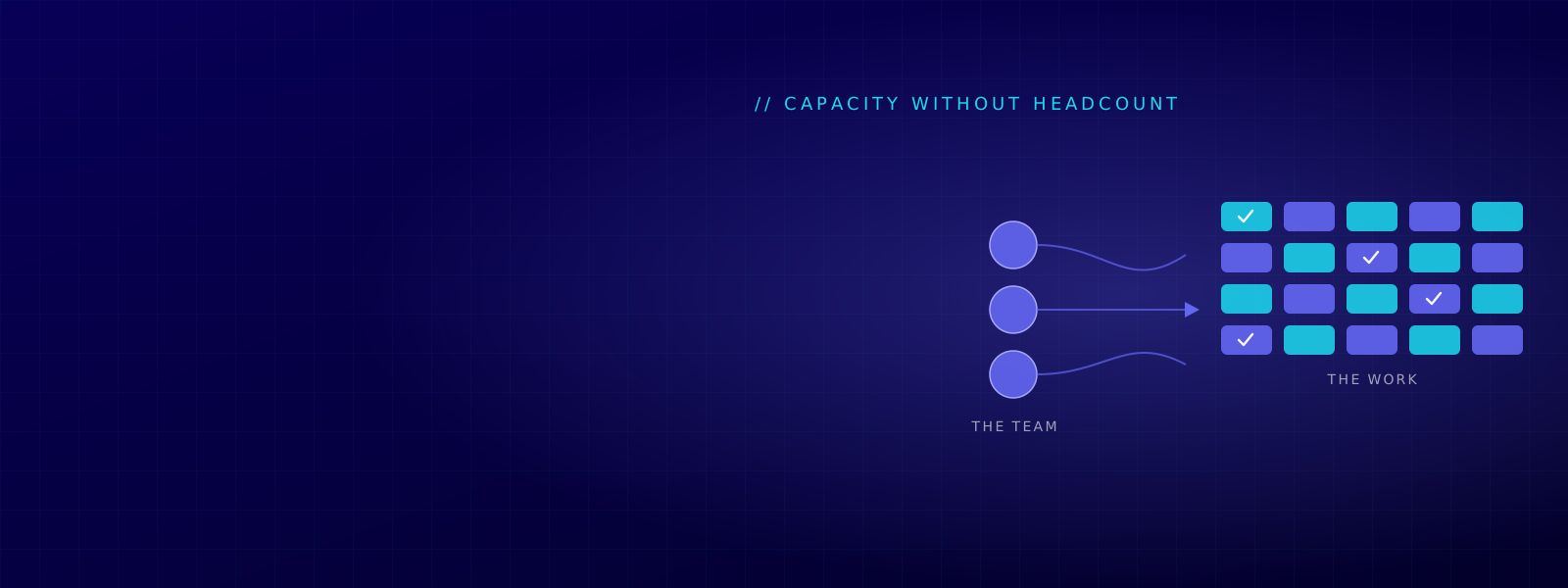
This is the shift that changes the math. When the work is mapped, expert agents can hold the busywork: drafting the content, building the pages, wiring the tracking, and scheduling the promotion across every channel. People stay where people add the most value: on strategy, brand, and judgment. They review and approve rather than assemble. The team does not get replaced, it gets leverage. A senior team of a few can direct the output of a much larger one, because the parts that used to eat their week are held by the system and steered by them.
One plan, one memory, so the work compounds
Leverage only lasts if it accumulates. In most teams the know-how lives in people’s heads, so when someone leaves, the next person relearns it and the team starts over. A real operating model runs on one plan and one shared memory: what worked, what did not, how the programs ran, and the context behind them. The system holds it, not individuals. Every cycle then makes the next one faster, and the learning stays with the business when people change. That memory is what Central Intelligence is built to hold.
You can always show what the team did
There is a quieter benefit to running the whole plan in one system, and it shows up the moment someone asks what marketing has actually done. Because the plan is tied to the number and every task runs through the same system, all of it is tracked as it happens. At any point you can answer the question every leader eventually asks: what did the team ship this week, this month, this year? You can go down to the individual tasks that made up the work and everything that went on around them.
That changes the conversation with leadership. Most teams struggle to articulate what they are doing week to week. With the work in one place, you can show the full output against the plan, where it is on track and exactly what slipped, without reconstructing a report from memory. That detail is worth more than it looks: it is how you build confidence, defend a budget, and learn what it actually takes to scale growth.
It also changes how the work feels to run. Programs are shipping, others are moving toward publishing, and distribution is running across several at once, all at the same time. From the outside that can look like a lot; from the inside it stays calm, because the pre-wiring leaves nothing to chance. Having your finger on the pulse is not a talent, it is what a real system of work makes easy.
What this looks like heading into budget season
When the ask is more output from a flat team, you have a better answer than hire or cut. You can show that the plan is achievable because the busywork is held by agents and the team is directing it, that the stack is consolidated around one system instead of many, and that the cost of coordination is coming down while output goes up. That is a defensible budget position: not a bigger team, a better operating model. Start by finding the overlap with a martech stack audit.
Do-more-with-less is not a call to work harder or spend less. It is a signal to change how the work gets done. Map the work, let agents hold the busywork, run it on one plan and one memory, and a lean team stops being the constraint and starts being the advantage.
See how the model works across the whole go-to-market motion on the platform overview, or start with one workflow on Getting started.